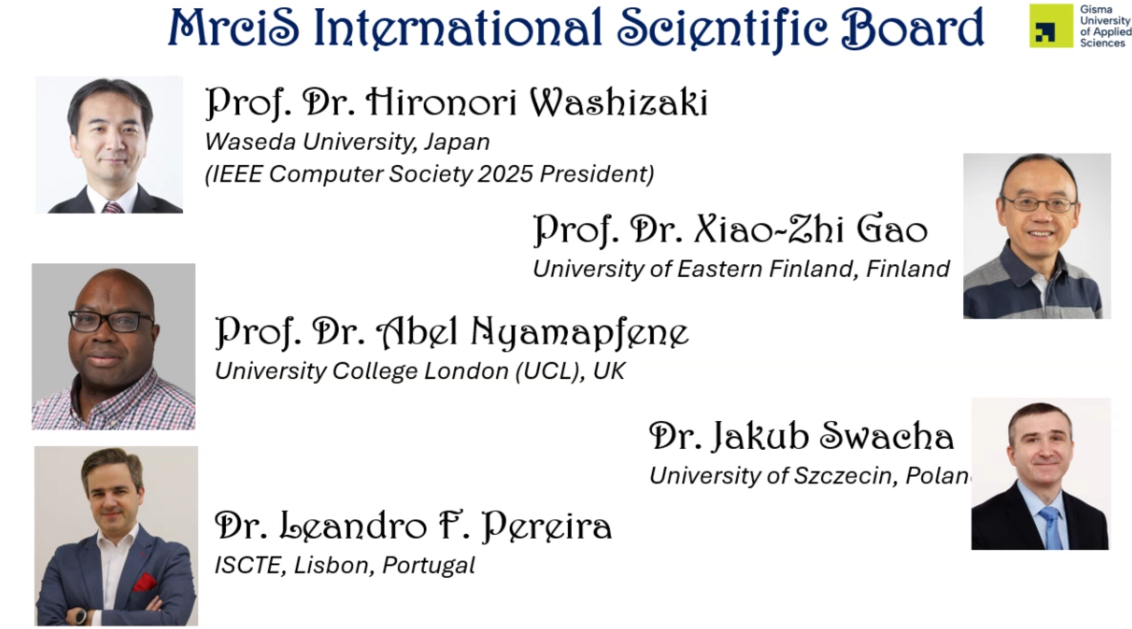
Prof. Washizaki is honoured to join the Scientific Advisory Board of the Multidisciplinary Research Centre for Innovations in SMEs (MrciS), led by Director Prof. Varun Gupta, at Gisma University of Applied Sciences in Germany.
カテゴリー別アーカイブ: 未分類
9/27(土)開催 Pattern Meetup@Yokohama
9/27(土)開催Pattern Meetup@Yokohamaにて、『アジャイル品質パターン「QA to AQ」の概要、事例、価値』と題し鷲崎教授ほか事例解説予定。他にも『高齢者向けホームのケアと場づくりのパターン・ランゲージ』の事例紹介やパターンワークショップ他。ご参加ください。
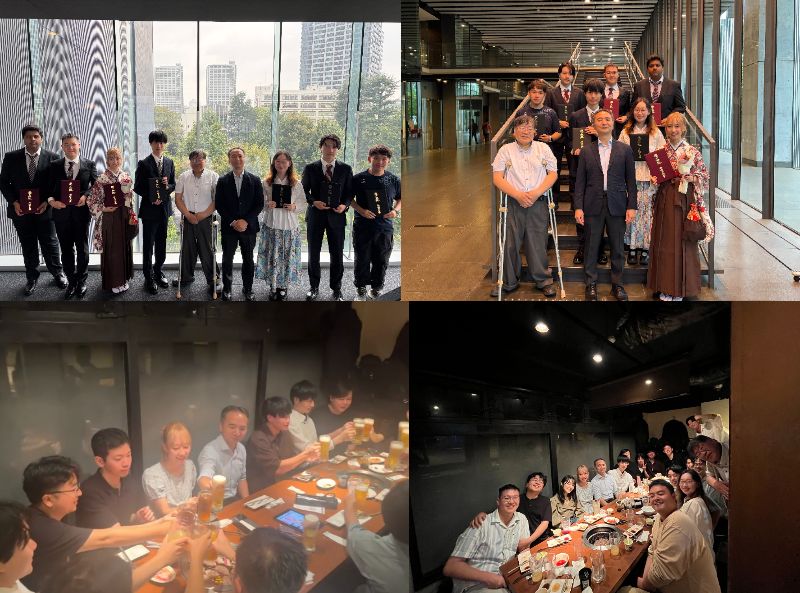
Three undergraduates and four Master’s course students (September enrollment) successfully graduated
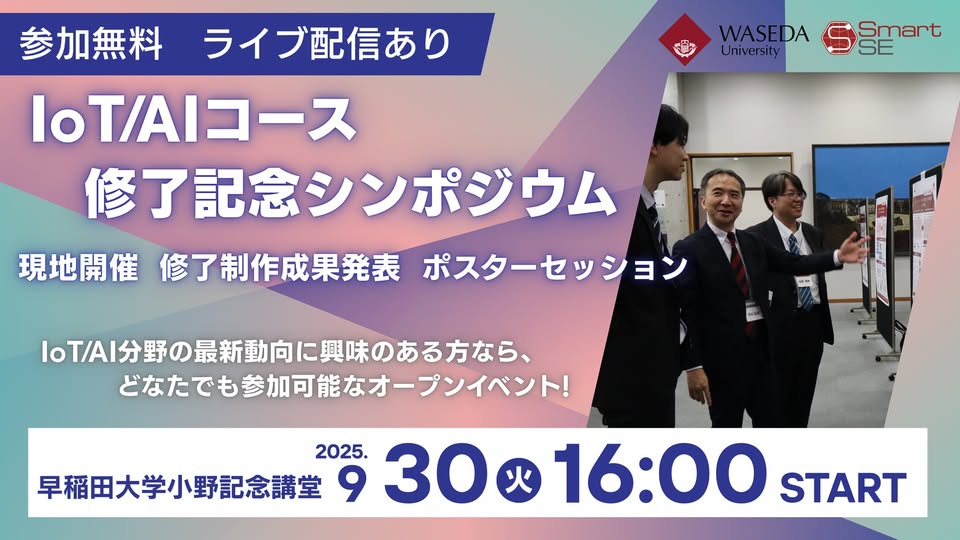
9/30 スマートエスイーIoT/AIコース修了記念シンポジウム無料開催
9/30 スマートエスイー シンポジウム無料開催。EARTHBRAIN社 谷副社長からのご講演「スマートコンストラクション」をはじめ、生成AIやIoTほか活用の優れた修了制作の講演、ポスター発表ほか充実の内容。ぜひご参加ください!
SES2025にてチュートリアル「LLM/生成AI&エージェントによるソフトウェア開発の実践と展望 – 設計からテスト,さらには組織や業界のあり方まで –」実施
SES2025にてチュートリアル「LLM/生成AI&エージェントによるソフトウェア開発の実践と展望 – 設計からテスト,さらには組織や業界のあり方まで –」(鷲崎、鵜林、増田、徳本、竹之内、斎藤)実施。スライド資料を公開しました。多くのご参加、ありがとうございました!
・生成AIのソフトウェア開発へのインパクト
・生成AIによるソフトウェアの要求と設計
・生成AIによるプログラムの実装
・生成AIによるプログラムのテスト
・生成AIに基づくソフトウェア開発のプロセスとマネジメント
・生成AIによるソフトウェア産業の将来
SES2025開催ホスト、3件表彰
Thanks to all organizers (incl. Prof. Tei-sensei) and volunteers, our campus of Waseda University successfully hosted the largest Japanese software engineering symposium, called SES2025, sponsored by IPSJ-SIGSE with IEEE Computer Society Tokyo/Japan Chapter and our lab as well as industrial sponsors.
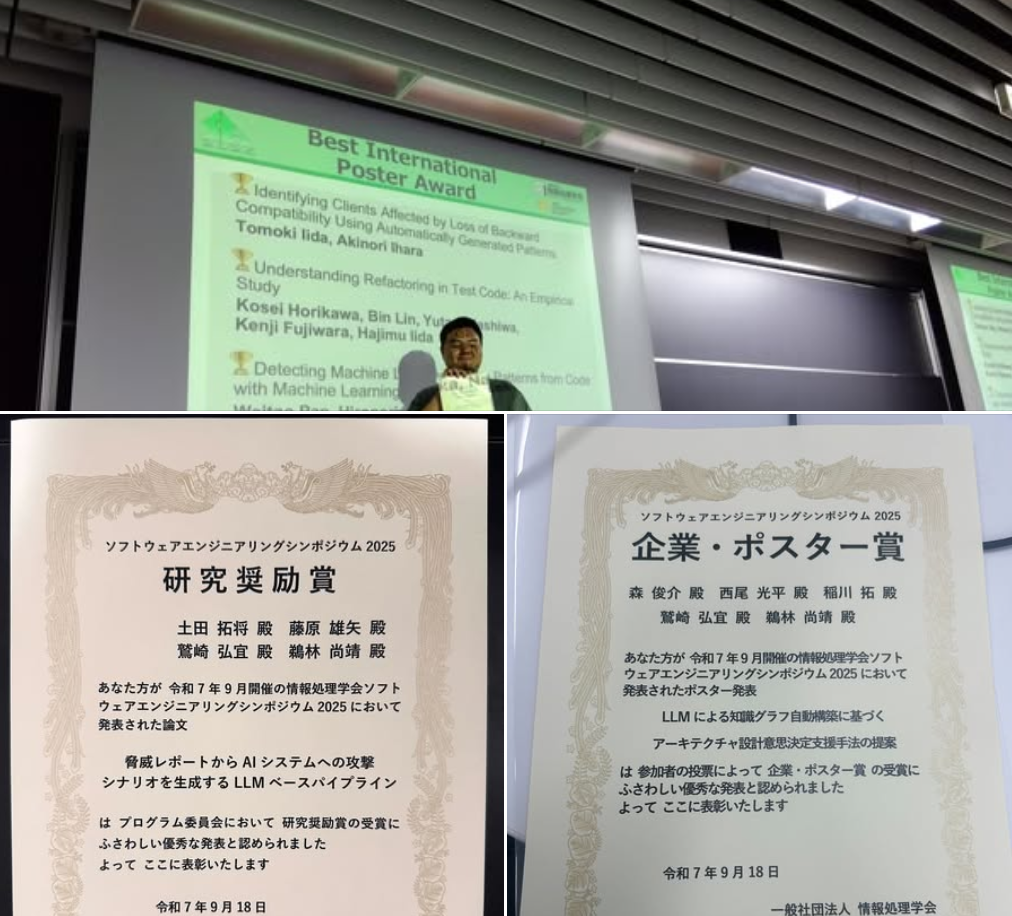
SES2025では3件の表彰を受領。ありがとうございました! 研究奨励賞(脅威レポートからの攻撃シナリオ生成、土田ほか)、企業ポスター賞(アーキテクチャ設計意思決定支援、森ほか・デンソー共同)、Int’l Poster Award(ML pattern detection, PANほか)
第1回 Pattern Meetup @Yokohama 9月27日開催
ソフトウェアに限らず幅広くパターン全般の国際会議AsianPLoP 2026横浜・三菱電機オフィス3/27-29開催予定。その助走としてパターンのハンズオンや事例紹介中心のワークショップ+ネットワーキングとなるPattern Meetupを9月27日(土)同じ場所で無料開催。ぜひ参加下さい!
2027年4月 研究室配属生・プロジェクト研究履修 募集中 Seeking Undergraduates and Project Research Students
Washizaki-Ubayashi Laboratory is recruiting project graduate students to work on the following themes. 鷲崎・鵜林研究室では以下のテーマに取り組むプロジェクト研究生を募集しています。
- GenAI/Agent-driven software development 生成AI・エージェント駆動ソフトウェア開発 (AI for SE)
- Software development foundation for high reliability and efficiency, enhanced by generative AI and agents 生成AI・エージェントにより増強されたソフトウェア高信頼化・高効率開発基盤
- Why Are Agentic Pull Requests Merged or Rejected? An Empirical Study (MSR’26)
- Toward Evidence-Based Architectural Decision Making Over Fragmented Knowledge (ICSA’26)
- LLM-based framework for semantic synchronization across multiple models in MDE (COMPSAC’26)
- Landscape and Taxonomy of Prompt Engineering Patterns in Software Engineering (IT Pro’26)
- Advanced software requirements analysis, design modeling, defect reporting analysis, and development support through collaboration between AI agents and humans AIエージェントと人の協調連携による高度なソフトウェア要求分析・設計モデリング,問題報告分析,ならびに開発支援
- ArgRE: Formal Argumentation for Conflict Resolution in Multi-Agent Requirements Negotiation (IEEE Access’26)
- Associated Personas: Linking Stakeholders to Traceable Requirements (RE’26)
- QUARE: Quality-Aware Requirements Analysis Through Multi-Agent Dialectical Negotiation (RE’26)
- Generating User Clones from Questionnaires: A Lightweight Approach to Requirements Elicitation (SANER’26)
- Generative ai for requirements engineering: A systematic literature review (SPE’26)
- Persona Generation from User Logs and Inquiries: Identifying Pain Points Beyond Actual Inquirers (IEICE’26)
- Software development foundation for high reliability and efficiency, enhanced by generative AI and agents 生成AI・エージェントにより増強されたソフトウェア高信頼化・高効率開発基盤
- Quality of complex systems including AI systems AIを中心とした複雑なシステムとプロセスの品質保証 (SE for AI):
- Enhancing the reliability of mobility AI and autonomous driving systems through multifaceted modeling and AI model repair セキュリティ・セーフティを含む多面的モデリングとAIモデルリペアを軸としたソフトウェア工学によるモビリティAI・自動運転システムの高信頼化
- Lightweight Risk-Aware Trajectory Planning for Edge-Intelligent Vehicular Internet of Things Systems (IoT-J’26)
- Adaptive Takeover Time Budget Allocation in Automated Driving: A Physiology-Aware Semantic Agent Framework (TCCN’26)
- Collaborative Intelligence in Cyber-Physical-Social Systems: An Adaptive Evolutionary Framework for Safe Autonomous Vehicle Interactions (IJPCC’26)
- Machine Learning Application Argument Patterns and Support Framework for Assurance Case Construction (JISE’26)
- Data-driven and Scenario-based Risk Analysis Considering Uncertainty in Machine Learning Systems (SFPVV’25)
- Security threat and risk analysis, verification, and countermeasures for complex software systems, including AI systems 生成AI・エージェントを活用したAIシステムを含む複雑なソフトウェアシステムのセキュリティ脅威・リスク分析・論証および対策
- Evaluation and improvement of software development processes and human factors ソフトウェア開発プロセスや人間的側面の評価と改善
- Quantum software engineering centered on quantum program repair 量子プログラムリペアを中心とした量子ソフトウェア工学
- (under review)
- Enhancing the reliability of mobility AI and autonomous driving systems through multifaceted modeling and AI model repair セキュリティ・セーフティを含む多面的モデリングとAIモデルリペアを軸としたソフトウェア工学によるモビリティAI・自動運転システムの高信頼化
- Education and Body of Knowledge in ICT and programming ICT・プログラミング人材育成・体系化
- Programming and information education for young people 若年層等を対象としたプログラミングおよび情報教育
- Processes that utilize knowledge systems and international standards 知識体系と国際規格を活用する開発および運用のプロセス実現
- Guide to the Software Engineering Body of Knowledge (SWEBOK Guide), Version 4.0a (IEEE Computer Society, 2025)
- History and Future of the SWEBOK Guide: Guide to the Software Engineering Body of Knowledge (COMPSAC’26)
- Recurrent education for working people in the fields of IoT, AI, and IoT IoT,AI,IoT分野の社会人リカレント教育
Research Procedures 研究の進め方 :
- Graduation Research Procedures: Same as below. However, a more in-depth approach throughout the year.
- Project research: Work in research groups. In the first month, students deepen their basic learning, then in the second and third months, they start to consider some viewpoints and studies, and in the fourth month, they summarize the results through discussions and experiments.
- Research theme setting: New or continuing development in the research group. The trend is that more and more students are taking over or sharing data and results of their seniors, and consulting with their seniors and others rather than working on new content by themselves.
- Seminar times: All international course students meet together on Mondays (around 5th period), and in groups on Thursdays (3rd, 4th, 5th periods), and so on. The schedule will be adjusted according to the course enrollment of newly assigned students.
- 卒業研究の進め方: 以下と同様。ただし年間を通してのより深い取り組み。
- プロジェクト研究の進め方: 研究グループに分かれて取り組み。最初の一か月ほどは基礎的な学びを深め、続いて二・三か月目に何らかの視点や検討を始め、四か月目に議論や実験などしつつ成果まとめ。
- 研究テーマの設定方法: 新規、あるいは、研究グループにおける継続発展課題。傾向としては新規の内容に一人で取り組むよりも、データや先輩の成果を引き継ぎ、あるいは共有して、先輩他とも相談しつつ取り組むケースが増加中。
- ゼミの曜日時限: 全体としては月曜日5限、他にはグループごとに主に木曜日3-5限。新配属生の科目履修状況によって適宜調整。
Prof. Washizaki had the opportunity to provide his remarks at the great IEEE International Requirements Engineering 2025 conference (RE2025)
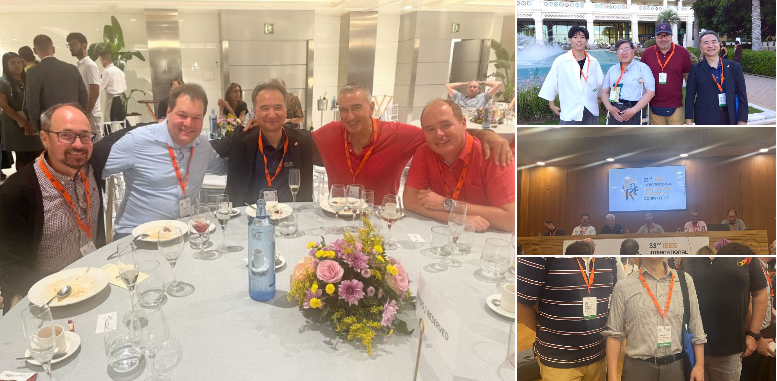
Thanks to General Chairs Oscar Pastor and Jose Ignacio Panach, PC Chairs Alessio Ferrari and Norbert Seyff, the Steering Committee, and all leadership, organizers, sponsors, and volunteers, Prof. Washizaki had the opportunity to provide his remarks at the great IEEE International Requirements Engineering 2025 conference (RE2025) in beautiful Valencia, where the IEEE Computer Society is the main sponsoring technical society.
From our lab with Ubayashi-sensei, Ryota Sugiyama presented our paper titled “Continuous Data-Driven Personas Generation: An LLM-based Knowledge Graph Approach.”
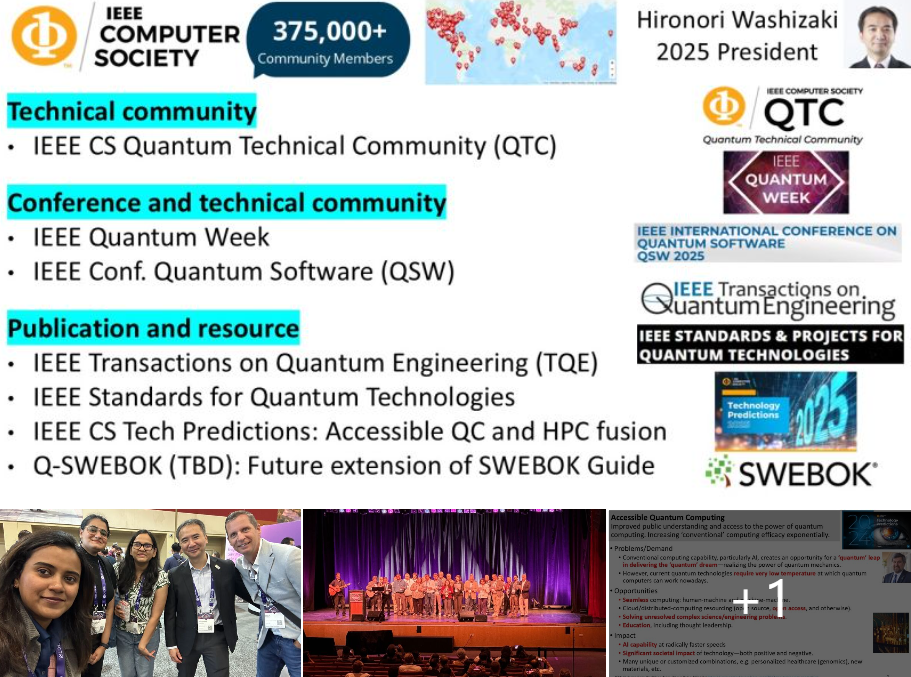
Prof. Washizaki provided his remarks at the conference IEEE Quantum Week 2025
Prof. Washizaki provided his remarks at the conference IEEE Quantum Week 2025 in Albuquerque, New Mexico, where the IEEE Computer Society is one of the main sponsoring IEEE technical societies. This year, it has attracted over 1,800 registrations, demonstrating the rapid growth of the Quantum Computing community.